Can't tell if your skincare product is actually working?
Often you can't tell because you don't know how often you really used it. Give the product a fair trial: one new product at a time, used as the label says, for a set number of weeks, with a dated record of every use and of how your skin looked. Then the answer comes from the record, not from memory.
Why it is so hard to tell
A new serum rarely changes your skin overnight, so the judgment you make is about weeks, and memory is bad at weeks. Three things usually get in the way:
- You don't know how often you used it. "Most nights" can mean six a week or three. If the product sat on the shelf for half the trial, its result says little about the product.
- Several things changed at once. A new serum, a new sunscreen and a new season in the same month leave you with no way to say which one made the difference.
- You only remember the extremes. A bad breakout week sticks; four calm weeks fade. Without a note made at the time, the trial is judged on one memorable day.
Give the product a fair trial
- Start one new product at a time. The American Academy of Dermatology advises introducing one new product at a time, and adds that consistency matters more than a 10-step routine.
- Decide the trial length before you start. Take it from the label or your dermatologist and write the end date down. For acne treatments, the AAD says to use a product for 6 to 8 weeks and to try another one if there is no improvement by then, rather than switching every week or so.
- Use it exactly as directed. Same step, same time of day, on the days the label says. A trial with many missed days is not a fair trial yet.
- Rate your skin the same way each day. Same mirror, same light, ideally in the morning before any product goes on. A word or two is enough: "calm", "two new spots", "dry patch on chin".
- Keep progress photos where you keep photos. Same spot and light each week, in your phone's camera roll.
If your skin reacts (redness, itching, swelling), the AAD says to wash the product off and not use it again. That ends the trial; whether something is a normal adjustment or a reaction is a question for a dermatologist or pharmacist, not for a log.
Log every use and a daily skin check
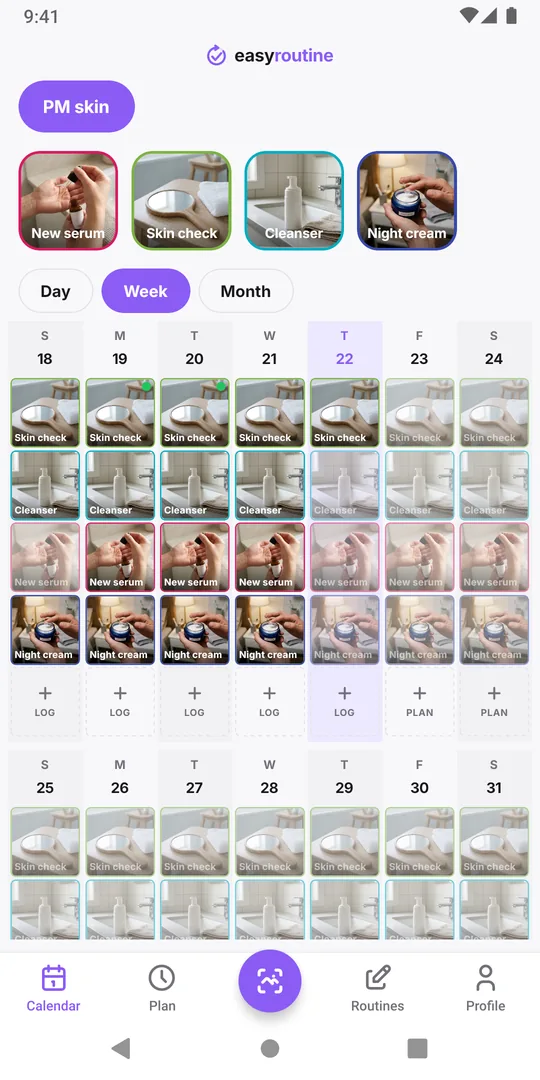
In EasyRoutine, give the new product its own activity, for example New serum in your PM skin routine, next to Cleanser and Night cream. Add a photo of the bottle and you can log it by pointing the camera at it with the round AI snap to log button in the middle of the tab bar: a match logs it at once with the current time. Or tap + Log on the day and tick it with the other steps. How the photo scan works.
Then add one more activity, Skin check, and log it each morning with a flag: green for a good day, amber for so-so, red for a bad one, plus a short note when something changes. Logging, notes, flags and the scan are free.
Keeping the skin rating on its own activity matters: it gets a rating every day, including the days you skipped the product, so you can compare the two.
Read the record: use first, then the flags
At the end of the trial, check consistency before you judge the product:
- Tap the product's tile above the calendar to highlight its entries.
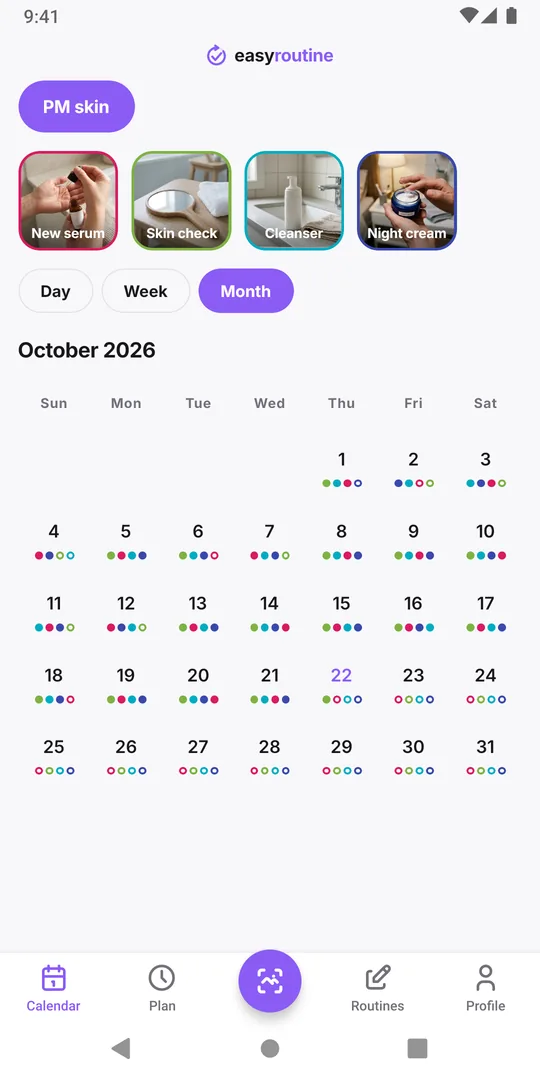
- Switch to the month view. Each day you used it has a dot in its color. A month with long gaps tells you the trial was not fair yet; extend it rather than give up on the product.
- Switch back to the week view and tap the Skin check tile. Flags show as small colored dots on each log. Step back week by week: did the amber and red days thin out after you started using the product consistently?
The month view shows when you used something, not the flag colors, so read the flags in the week or day view. If the flags turned green in the same weeks you were consistent, that is a reason to keep going; if they did not change after a full, consistent trial, that is worth raising with your dermatologist.
What a log can and cannot tell you
EasyRoutine records that and when you used a product, plus your flag and note. It has no charts, does not analyze ingredients and does not judge whether a product works. Skin also changes for reasons that are not in your routine, so the record is something to think with and to show a dermatologist, not a verdict.
If the question is the opposite one, which product caused a reaction, see how to find which skincare product caused a reaction. For a product you use for a fixed number of weeks, the skincare treatment tracking template shows how to give it start and end dates. More on the skincare routine tracker.
Common questions
How long should I use a skincare product before deciding if it works?
Follow the label or your dermatologist. For acne treatments, the American Academy of Dermatology says to use a product for 6 to 8 weeks before trying another. Decide the length before you start and write down the end date.
Should I log the nights I skipped the product?
No. Every log counts as a use. Leave the night empty, so the gaps in the month view show how consistent the trial really was.
Can I add photos of my skin to a log?
No. A log holds a time, a note and a flag, and the one photo on an activity is for the product. Keep skin photos in your phone's camera roll.
Is tracking a product trial free?
Yes. Logging, notes, flags, the photo scan and the calendar are free. Premium adds schedules and reminders, which are optional here.
Keep reading
- Skincare routine tracker apps compared: dedicated app or EasyRoutine?Skincare apps offer ingredient checks and photo diaries; EasyRoutine logs which AM and PM steps you used and when. Features compared, and who fits which.
- Morning skincare routine order: a simple checklistMorning skincare routine order: cleanser, serum, moisturizer, then sunscreen last. A sourced checklist, common mistakes and a simple way to track each step.
- Evening skincare routine checklistAn evening skincare routine checklist in the right order, how it changes on retinol and no-makeup nights, the mistakes to avoid, and how to track the steps.
- How to track a skincare treatment and know when to stop itA template for a skincare treatment that comes and goes: write the plan down, log each use, note how your skin reacts, and know when to stop it.
- Which skincare product caused my skin reaction?Skin reacting to something new? Narrow down the product: compare start dates, know how patch testing works, avoid common mistakes, and keep a dated log.
- Did I do my morning skincare or not?Not sure if you did your morning skincare or put on SPF? Quick checks, what to do when in doubt, and a two-second way to know for sure tomorrow.
- Forget to patch test new skincare products?Keep forgetting to patch test new skincare? How a home patch test works, why it gets skipped, and how to make it a short step of its own on your calendar.
- Keep forgetting your evening skincare routine?Keep forgetting your evening skincare? Why the PM routine slips, how to shrink it and tie it to a cue, and how a reminder can catch you before bed.
- Lose track of where you are in a long retinol introduction?Losing track of which week of your retinol introduction you are on? Write the phases down, put them on a calendar and see which nights you actually used it.
- Should you track morning and evening skincare in the same list?Should you track morning and evening skincare in the same list? When two routines work better, when one is enough, and how to set either up.
- Running two skincare treatments at once and getting them mixed up?Running two skincare treatments at once and mixing them up? Give each its own entry, nights and end date, and keep a record you can tell apart later.
- Does your skincare routine fall apart when you travel?Skincare routine falls apart when you travel? Pick a travel minimum, pack for it, adjust for time zones, and keep a record even when steps move around.
Free on iPhone and Android. Sign in with Apple, Google or your email to start.