A bearded dragon care schedule: feeding, cleaning and UVB bulb changes
A bearded dragon care schedule runs on three clocks: daily feeding and spot cleaning, a monthly full clean, and long-cycle jobs like replacing the UVB bulb on the date its manufacturer gives. EasyRoutine logs every job for free, and with Premium it reminds you on the day each one is due.
What should a reptile care schedule include?
Reptile care involves jobs with very different intervals. Some happen every day, others once a month, and some only a few times a year. A typical care checklist for a bearded dragon or leopard gecko includes:
- Feeding, on the days your species and its age need.
- Spot cleaning droppings and leftover food.
- A full enclosure clean, including the equipment inside.
- A substrate change, if you use a loose substrate.
- UVB lamp replacement, according to the lamp manufacturer's schedule.
- Weight and shedding, which you monitor and record rather than schedule as care tasks.
The RSPCA's care sheets provide a starting point for the first three tasks. For bearded dragons, it says babies are fed twice daily and juveniles and adults once daily. Droppings should be spot cleaned as soon as they appear, and the vivarium should receive a full monthly clean with a reptile-safe disinfectant, rinsed off well (RSPCA: bearded dragon care). For leopard geckos, it says juveniles are fed daily and adults every other day, with the same spot cleaning and a monthly full clean of the vivarium and all equipment (RSPCA: leopard gecko care). A specialist reptile vet can adjust these tasks for your animal.
When should you replace a bearded dragon's UVB bulb?
A UVB lamp can keep glowing long after its UVB output has dropped, so you cannot judge its effectiveness by looking at it. The RSPCA says UV output decreases over time, recommends checking it regularly with a UV Index meter, and advises replacing the lamp when the manufacturer recommends. The replacement interval is therefore the one on the lamp's box or the manufacturer's website, not a general rule of thumb.
Write down the installation date and replacement interval when you fit a new lamp. The box may be gone by the time you need the information again.
Substrate replacement also depends on the type of substrate and your setup. Follow its manufacturer's instructions and your vet's advice. For leopard geckos, the RSPCA advises against calcisand, beech chips and other non-natural loose substrates, and recommends non-loose substrates while geckos are very young.
Common bearded dragon care schedule mistakes
- Trusting a bulb because it still lights up. Record its replacement date when you install it.
- Using one "cleaned the tank" entry for everything. Spot cleaning and a full clean with disinfectant are different jobs. You need to know when the last full clean happened.
- Weighing only when something seems wrong. The RSPCA suggests weighing your dragon or gecko regularly. Recording past weights makes changes easier to identify.
- Pulling at stuck shed. The RSPCA warns that pulling off stuck skin can tear the new skin underneath. Record the issue and ask your vet if it does not come off.
- Skipping hand washing. Reptiles can carry salmonella, and the RSPCA advises washing your hands before and after cleaning or handling.
How to track bearded dragon feeding, cleaning and weight (free)
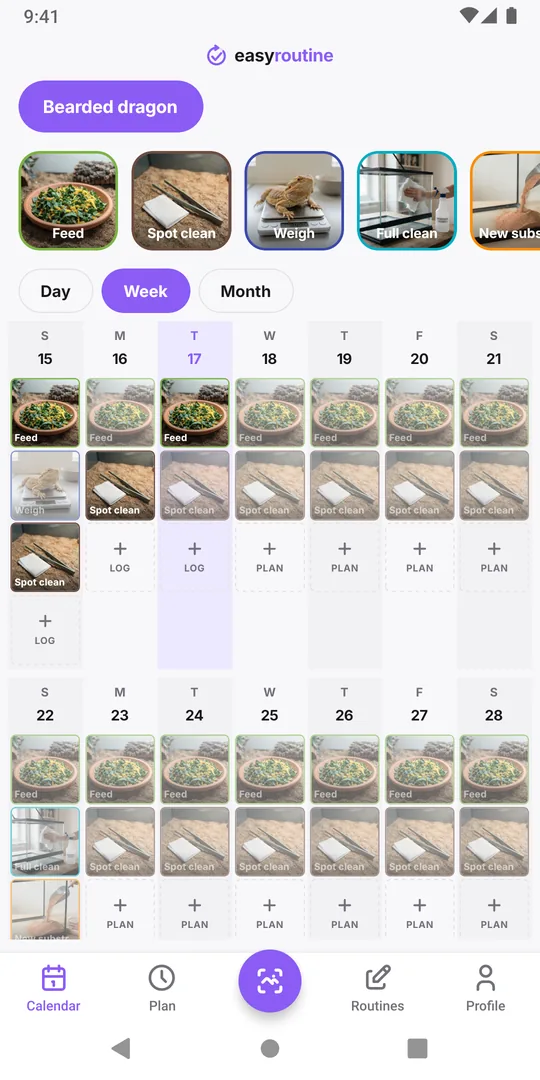
In EasyRoutine, create a routine named after your animal or species, such as Bearded dragon, and add each care task as its own activity: Feed, Spot clean, Full clean, New substrate, UVB bulb and Weigh. After completing a task, tap + Log on the day and select it. Forgot to log yesterday's spot clean? Add it to yesterday instead.
Use the comment on each log to record details. For Weigh, enter the number from your scales and anything you noticed, such as "412 g, shedding started" or "stuck shed on toes". You can also set a red, amber or green flag to make entries worth showing your vet easier to identify.
For UVB bulb, record the lamp type and the replacement interval printed on its box. This gives you the information you need when buying the next one. EasyRoutine stores your text, but it does not track weights, read your scales or judge whether a number is good. How logging works.
How to schedule daily and monthly reptile care (Premium)
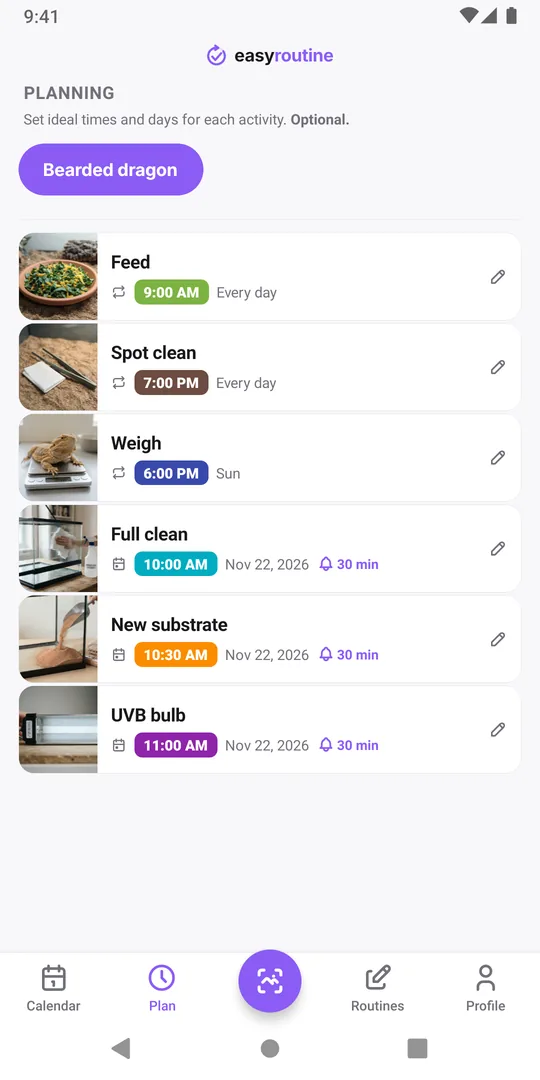
With Premium, the Plan tab lets you schedule each activity separately. Recurring schedules use weekdays and an optional time: Feed every day at 9:00 for a dragon fed once daily, Spot clean every day at 19:00, and Weigh on Sundays. Every other day does not fit a seven-day week exactly, so for an adult leopard gecko, a pattern such as Monday, Wednesday, Friday and Sunday comes close. Check with your vet that it suits your gecko.
There is no "every 30 days" rule, so schedule monthly and longer-term jobs as Single day plans. Add the next full clean on its date, the substrate change on the date you chose, and the UVB bulb replacement on the date given by the manufacturer's interval, counted from the installation date.
Each activity holds up to 20 single-date plans. You can schedule a year of monthly cleans at once, or add just the next clean and schedule the following one after you complete it. A planned task you have not logged stays faded on the calendar, making a skipped full clean easy to spot. More about scheduling.
Tips for organizing your reptile care schedule
- EasyRoutine does not know your species, lamp or substrate. Get care intervals from your vet, care sheets such as the RSPCA's, and the manufacturers. The app remembers the dates.
- Keeping more than one reptile? Give each animal its own routine so feeding days and weight records never get mixed up.
- Changed to a different lamp type? Archive the old activity and add a new one. The history stays.
Other long-interval tasks work the same way. See the filter replacement reminder and the pet care tracker for dogs and cats.
Common questions
What should a daily bearded dragon care schedule include?
Include feeding and spot cleaning. The RSPCA says bearded dragon babies are fed twice daily and juveniles and adults once daily. Droppings should be spot cleaned as soon as they appear. Ask a specialist reptile vet about the right routine for your animal.
How often should I change a UVB bulb?
Follow the lamp manufacturer's instructions. The RSPCA says UVB output drops over time, recommends checking it regularly with a UV Index meter, and says to replace the lamp when the manufacturer recommends. Ask a specialist reptile vet if you are unsure.
Can I set a reminder to change the UVB bulb every few months?
Not as a repeating rule, because recurring schedules use weekdays. Add the replacement as a single-day plan on the date the manufacturer's interval gives, with a reminder. Scheduling and reminders are part of Premium.
How do I keep track of weight and shedding?
Add a Weigh activity and write the weight and any shedding notes in the log's comment, with a flag for anything unusual. When you log the next weigh-in, the log sheet shows your earlier comments for that activity. The app does not chart weights or interpret them; your vet does that.
Is the reptile care log free?
Yes. Logging jobs, notes, flags, the calendar and the photo scan are free. The weekly schedule, single-date plans and reminders need Premium.
Keep reading
Free on iPhone and Android. Sign in with Apple, Google or your email to start.